Know where to go when there's no GPS
Maps you should have on hand and how to read a compass correctlyIt’s easy to rely on a well-worn trail or glowing blue dot on your phone until the trail gets washed away or the battery doesn’t last quite as long as you thought it would. In especially the White Mountains, where weather shifts quickly and trails don’t always follow predictable patterns, navigation is a core safety skill.
Knowing where you are—and how to get where you’re going—starts before you leave home.
3 Maps You Should Always Pack
Paper
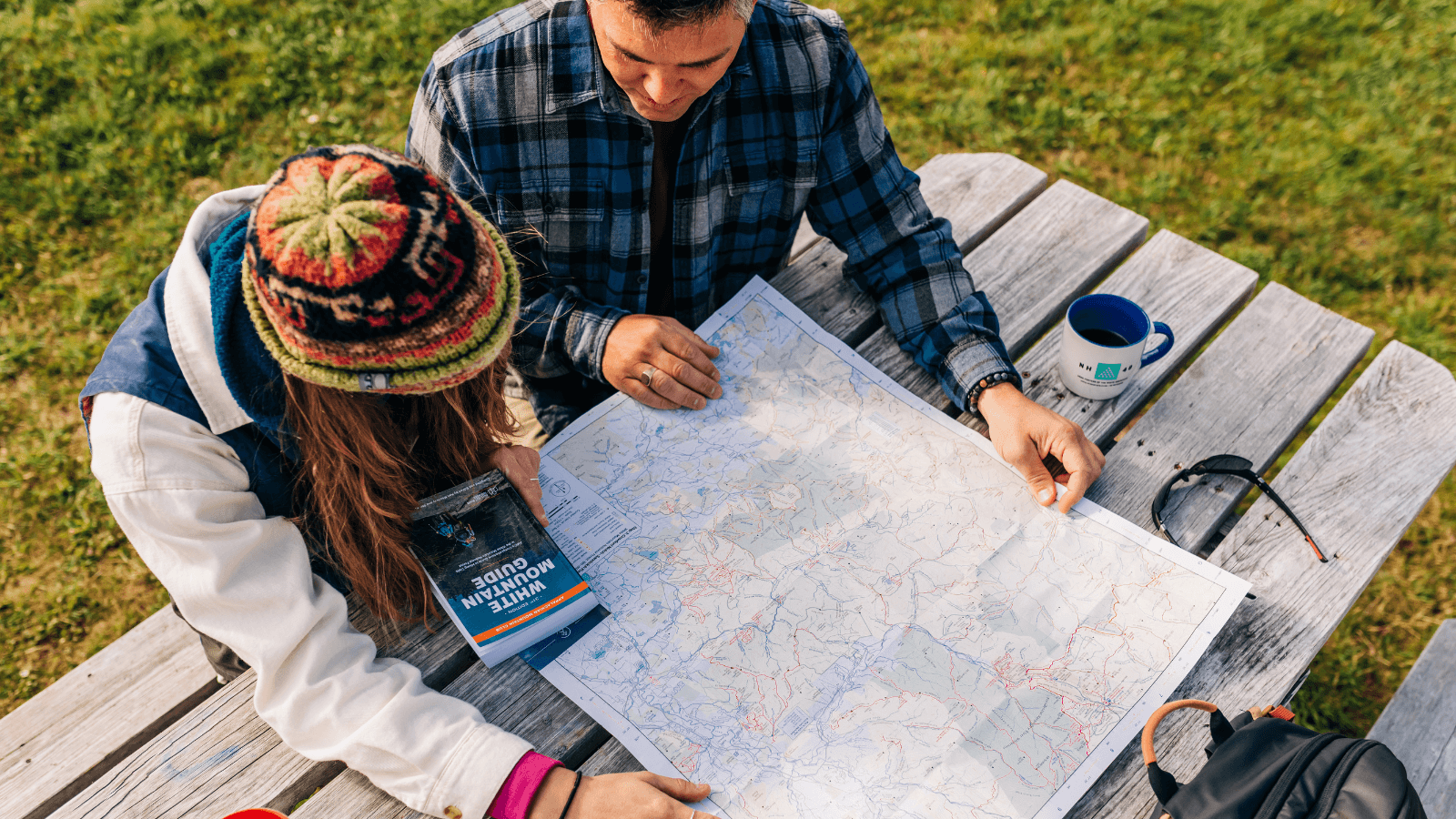
Good, old-fashioned paper is a must on every adventure. It never runs out of battery, it doesn’t lose service and if you buy a waterproof one, it’s immune to wet conditions. Look for maps that include trail networks, elevation and landmarks—not just simplified routes.
Mental Map
Always study your route ahead of time. Note junctions, water crossings, elevation gain, landmarks and bailout options. The map shouldn’t feel unfamiliar once you’re on a trail.
Digital (optional)
Apps like Gaia GPS, AllTrails or CalTopo are helpful if you download the map for offline use before losing service. Pack a portable battery, and don’t rely on your phone to be your only navigation tool.
How to read a map
A map is only useful if you understand what you’re looking at.
Contour lines
- Close together = steep terrain
- Spread out = gradual slope
- Circles = summits or depressions
Identify key features
Ridges, valleys, streams and trail intersections can help you confirm your location. Trails often follow natural features. Learning to recognize them matters.
Orientation
Always align your map with the landscape. If the terrain in front of you doesn’t match what’s on paper, stop and reassess.
How to use a compas
A compass paired with a map is the most powerful resource for navigation during your hike.
Orient your map
- Place your compass on the map
- Rotate the map until the needle aligns with north
- Now your map matches where you are facing in the real world
Putting it to use
- Identify your destination on the map
- Draw a line or visualize a straight line from your location
- Rotate the compass until it aligns with that line
- Turn your body until the needle matches the orienting arrow
- Follow that direction
How to make a compass (emergency only)
If you lose your compass, there are ways of improvising, but only as a last resort.
What you need
- A small metal object (pin, needle, etc.)
- A way to magnetize it (running it along fabric or hair can create a weak charge)
- Water and something that floats (leaf, small piece of plastic)
How to use it
- Magnetize the metal object by rubbing it repeatedly in one direction
- Place it on the floating surface in still water
- It will slowly align roughly north-south
*Note: This is not precise. It can help with general direction, but should not replace a real compass in serious navigation.
Common navigation mistakes
If you lose your compass, there are ways of improvising, but only as a last resort.
What you need
- A small metal object (pin, needle, etc.)
- A way to magnetize it (running it along fabric or hair can create a weak charge)
- Water and something that floats (leaf, small piece of plastic)
How to use it
- Magnetize the metal object by rubbing it repeatedly in one direction
- Place it on the floating surface in still water
- It will slowly align roughly north-south
*Note: This is not precise. It can help with general direction, but should not replace a real compass in serious navigation.